
Here are today’s CHM 100 notes. These notes discuss how to round the amswers of multiplying and dividing measurements. They also cover how to write numbers in scientific notation and how to enter scientific notation into a TI-83 (or similar) calculator.
Category Archives: The Old Stuff
CHM 110: Board notes for 1/29/09
Here ate today’s CHM 110 notes. These notes discuss the predictions of Dalton’s theory, subatomic particles, the nuclear model of the atom, and the periodic table.
CHM 111: Board notes for 1/28/09
Here are yesterday’s CHM 111 notes. These notes discuss the classification of solids by structure and the units for calculating the concentration of a solution.
CHM 100: Board notes for 1/28/09
Here are today’s CHM 100 class notes. These notes cover how to deal with the number zero in measurements and how to round answers when adding measured numbers.
CHM 110: Board notes for 1/27/09
Here are the notes from today’s CHM 110 class. These notes cover math with significant figures, exact numbers, and an introduction to Dalton’s atomic theory.
CHM 111: Board notes from 1/26/09
Here are today’s class notes. These notes cover intermolecular forces in liquids and how they affect liquid properties. They also cover the kinds of forces present in the solid state.
CHM 100: Board notes for 1/26/09
Here are today’s CHM 100 notes. These notes cover a few more dimensional analysis examples, then introduce accuracy, precision, and the concept of significant figures.
CHM 110: Board notes for 1/22/09
Here are the notes from Thursday’s CHM 110 class. These notes introduce the concepts of accuracy, precision, and significant figures.
CHM 111: Board notes from 1/21/09
Here are the notes from Wednesday’s CHM 111 class. These notes continue our discussion of valence bond theory from Chapter 10, then introduce the phases of matter from Chapter 11.
We discusses several chlorine-containing hydrocarbons during our talk about how double bonds work in valence bond theory. Here they are.
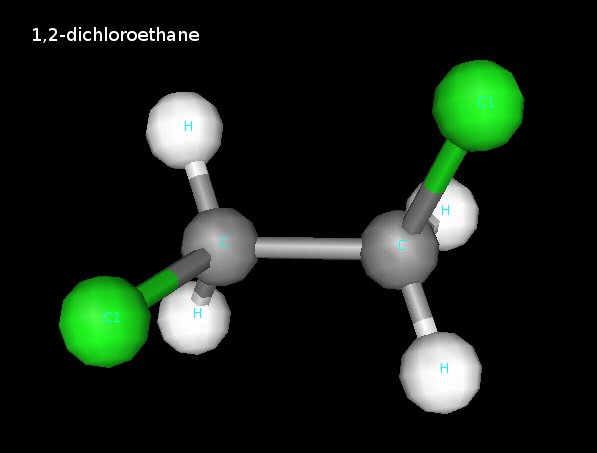
This is 1,2 dichloroethane. Both ends of this molecule are free to rotate around the C-C bond.
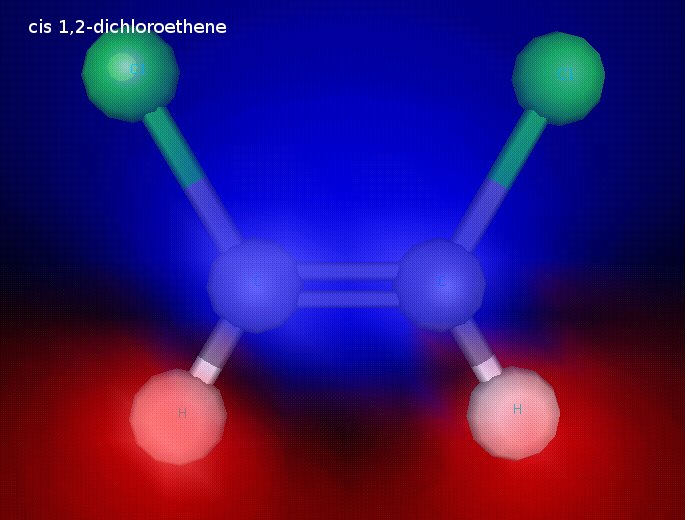
This is cis 1,2-dichloroethene. Both of the chlorine atoms are on the same side of the C=C bond. The chlorine atoms are fixed in this position because the double bond does not allow free rotation, since rotation would break the pi component of the double bond. This illustration shows electrostatic potential, and we can see that this molecule is polar.
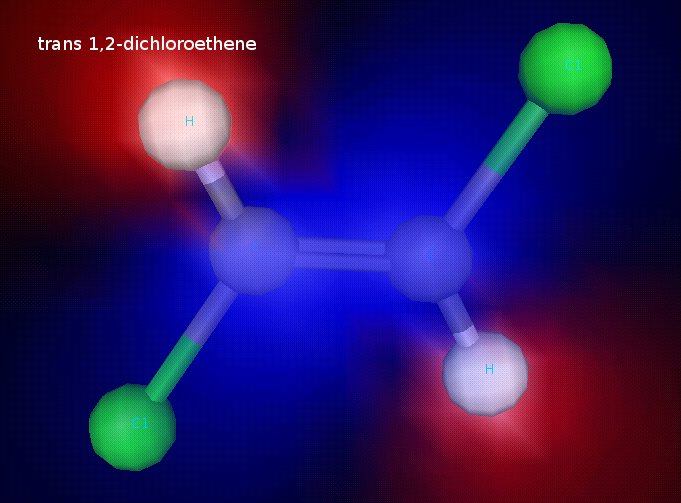
This is trans 1,2-dichloroethene. The chlorine atoms are on opposite sides of the C=C bond. The chlorine atoms are fixed in this position because the double bond does not allow free rotation, since rotation would break the pi component of the double bond. This illustration shows electrostatic potential, and we can see that this molecule is nonpolar. It also has observably different physical properties (like boiling point) from the cis form.
CHM 100: Board notes from 1/21/09
Here are the notes from today;s CHM 100 class. These notes discuss how to convert between units with dimensional analysis.