Here are today’s CHM 111 notes. These notes finish up our discussion of the colligative properties and introduce rate laws.
Any questions? Ask here!

Here are today’s CHM 111 notes. These notes finish up our discussion of the colligative properties and introduce rate laws.
Any questions? Ask here!
Here are today’s CHM 111 notes. These notes cover more about solution concentration, converting from one solution concentration unit to another, and hydration vs. lattice energy. These notes also introduce the colligative properties and how to determine molecular weight based on freezing point depression.
Any questions? Ask here!
Here are today’s CHM 111 notes. These notes introduce solutions and four common concentration units for solutions: mass percent, molarity, molality, and mole fraction.
any questions? Ask here!
Here are today’s CHM 100 notes. These notes continue our discussion of exchange reactions.
Any questions? Ask here!
Here are today’s CHM 111 notes. These notes cover properties of liquids (surface tension, viscosity, etc.), intermolecular forces, and classification and properties of solids.
Any questions or problems accessing the notes? Ask here!
Here are today’s CHM 111 notes. These notes cover valence bond theory and introduce solids and liquids.
Any questions? Ask here!
Here are today’s CHM 100 notes. These notes cover classification of reactions and introduce ionic theory and exchange reactions.
Any questions? Ask here!
Here are today’s CHM 111 notes. These notes introduce molecular shape and the polarity of molecules.
Any questions (or problems accessing these notes)? Ask here in comments!
Here are today’s CHM 100 notes. These notes cover how to name acids and how to identify from a name or a formula what kind of compound you have. These notes also introduce chemical equations and balancing.
[CHM 100: Board notes for 6/17/2010]
Any questions? Ask here!
Here’s formaldehyde. You can see the trigonal planar structure clearly. In some of these images, electrostatic potential is indicated with blue (for negative) and red (for positive) to show the polarity of these molecules. Formaldehyde is a polar molecule.
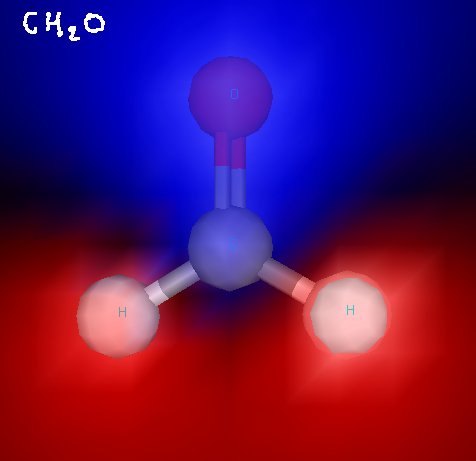
Formaldehyde - with ESP shading
Take a look at the pyramidal shape of ammonia. Its nitrogen atom is the top of the pyramid, while its hydrogen atoms form the base. Ammonia is a polar molecule.
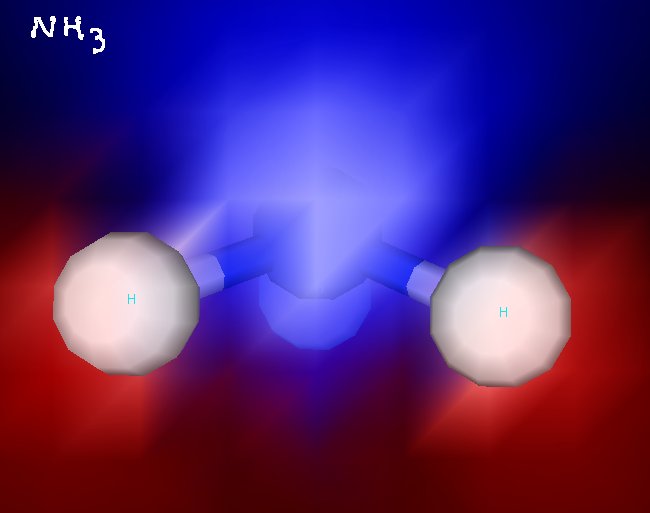
Ammonia - with ESP shading
Water is a bent molecule, which gives the molecule a hydrogen “side” and an oxygen “side”. This makes the molecule polar.
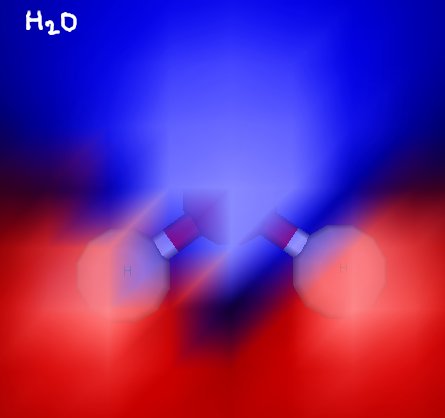
Water - with ESP shading
Difluoromethane is a molecule that, at first glance, may appear nonpolar. It has two hydrogen atoms and two fluorine atoms, but their tetrahedral arrangement around the central carbon atom makes the molecule have a hydrogen “side” and and fluorine “side”.
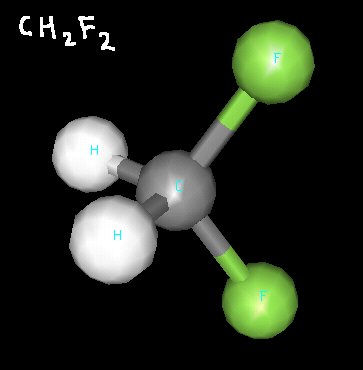
Difluoromethane
Since fluorine atoms are very electronegative, their arrangement makes difluoromethane a polar molecule.
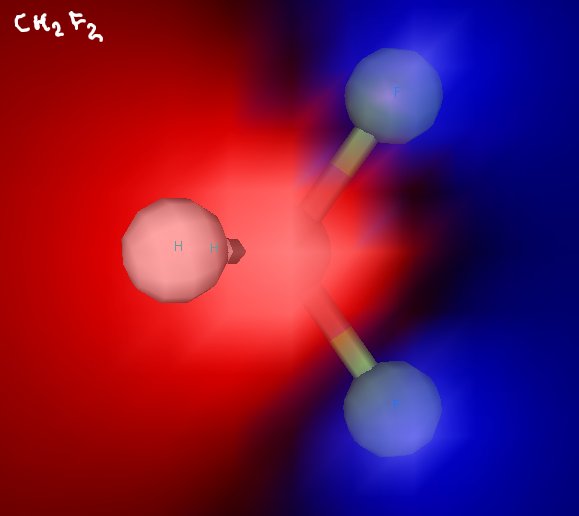
Difluoromethane - with ESP shading