Here are today’s CHM 111 notes. These notes cover properties of liquids (surface tension, viscosity, etc.), intermolecular forces, and classification and properties of solids.
Any questions or problems accessing the notes? Ask here!

Here are today’s CHM 111 notes. These notes cover properties of liquids (surface tension, viscosity, etc.), intermolecular forces, and classification and properties of solids.
Any questions or problems accessing the notes? Ask here!
Here are today’s CHM 111 notes. These notes cover valence bond theory and introduce solids and liquids.
Any questions? Ask here!
Here are today’s CHM 100 notes. These notes cover classification of reactions and introduce ionic theory and exchange reactions.
Any questions? Ask here!
Here are today’s CHM 111 notes. These notes introduce molecular shape and the polarity of molecules.
Any questions (or problems accessing these notes)? Ask here in comments!
CHM 110 students
Just a few quick announcements before tomorrow’s final exam:
Any last-minute questions? Ask them here! I will be checking periodically for questions until 11:00 PM tonight.
Here are today’s CHM 100 notes. These notes cover how to name acids and how to identify from a name or a formula what kind of compound you have. These notes also introduce chemical equations and balancing.
[CHM 100: Board notes for 6/17/2010]
Any questions? Ask here!
CHM 110- students:
If you’re in section 1, you may view your lab average (and your updated course average) on [Desire2Learn]. If you are in section 2, I will post your lab averages as soon as I receive them from Mr. Sneeringer.
Also, remember that CHM 110 lecture will not meet on Thursday morning (lab is unaffected). If you have any questions about the final, please drop by the office or leave a comment on this post.
(If there are any CHM 100 students reading this post, CHM 100 lecture meets as usual on Thursday!)
Remember to bring a calculator with good batteries to the final on Friday!
Here’s formaldehyde. You can see the trigonal planar structure clearly. In some of these images, electrostatic potential is indicated with blue (for negative) and red (for positive) to show the polarity of these molecules. Formaldehyde is a polar molecule.
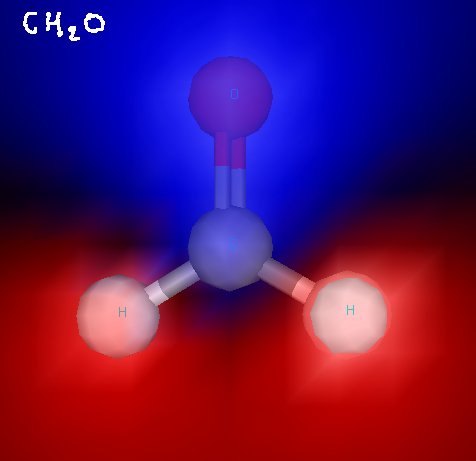
Formaldehyde - with ESP shading
Take a look at the pyramidal shape of ammonia. Its nitrogen atom is the top of the pyramid, while its hydrogen atoms form the base. Ammonia is a polar molecule.
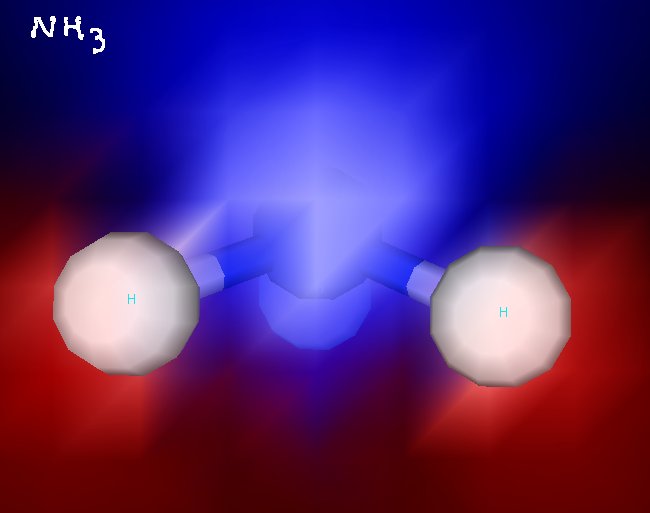
Ammonia - with ESP shading
Water is a bent molecule, which gives the molecule a hydrogen “side” and an oxygen “side”. This makes the molecule polar.
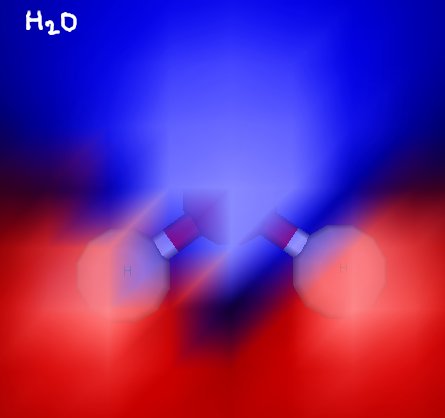
Water - with ESP shading
Difluoromethane is a molecule that, at first glance, may appear nonpolar. It has two hydrogen atoms and two fluorine atoms, but their tetrahedral arrangement around the central carbon atom makes the molecule have a hydrogen “side” and and fluorine “side”.
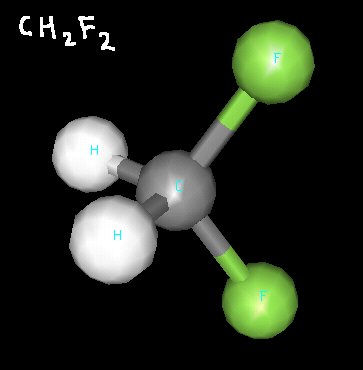
Difluoromethane
Since fluorine atoms are very electronegative, their arrangement makes difluoromethane a polar molecule.
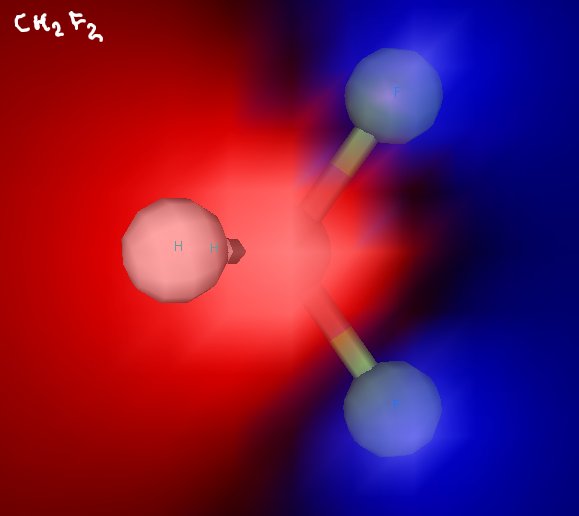
Difluoromethane - with ESP shading
Here are today’s CHM 110 notes. These notes cover molecular geometry and polarity.
Any questions? Ask here!
Here are today’s CHM 110 notes. These notes give more information about Lewis structures (expanded valence, resonance, formal charge) and introduce VSEPR.
Any questions? Ask here!